
Contents
- 1 The Charm of Goheimochi | A Comprehensive Guide for
- 2 to This Traditional Delicacy Beloved in Japan’s Mountain Villages
- 2.1 1. What Is Goheimochi? | A Traditional Dish Born in Japan’s Mountainous Regions
- 2.2
- 2.3 2. Why is it popular with foreigners? | Reasons why goheimochi is considered
- 2.4 4. The History of Goheimochi | A Food Culture Born from the Wisdom of Farmers
- 2.5 5. Goheimochi
- 2.6 Comparing
- 2.7 of the Travel Experience
- 2.8 6. Where can you eat Goheimochi?
- 2.9 7. Goheimochi and Japanese Culture | The Aesthetics of Enjoying “Simplicity”
- 2.10 Summary | Goheimochi: A Special Dish That Lets You Taste “Local Japanese Culture”
The Charm of Goheimochi | A Comprehensive Guide for
Foreign Visitors
to This Traditional Delicacy Beloved in Japan’s Mountain Villages
Many foreign tourists visiting Japan enjoy sushi and ramen, but in reality, there are still numerous exquisite local delicacies in the countryside that remain unknown to the world.
Among these, “Goheimochi” has been steadily gaining popularity in recent years.
Toasted rice, a sweet and savory miso sauce, and the aroma of charcoal.
Despite its simplicity, the surprisingly complex flavor is unforgettable once you try it.
In this article, we’ll provide a detailed introduction to Goheimochi for international travelers, covering its history, taste, regional variations, and connection to Japanese culture.
It’s the perfect dish for anyone looking to experience authentic Japanese local cuisine.
1. What Is Goheimochi? | A Traditional Dish Born in Japan’s Mountainous Regions
Goheimochi is a regional dish that has been enjoyed since ancient times, primarily in the Chubu region.
It has been particularly popular in mountainous areas such as Nagano, Gifu, and Aichi prefectures.
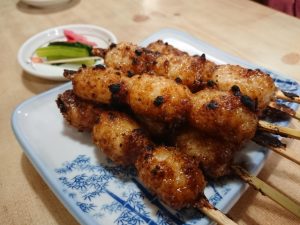
The basic preparation involves skewering mashed rice, grilling it over charcoal, and finishing it with a special miso sauce.
While it looks simple, the shape and flavor of the sauce vary significantly by region.
- Round dumpling shape
- Waraji-shaped
- Flat sandal-style
- Walnut miso sauce
- Soy sauce-based sauce
Each region has its own unique style, and the fun of “comparing different varieties” is part of the charm of goheimochi
.
2. Why is it popular with foreigners? | Reasons why goheimochi is considered
“typically Japanese
”
One reason foreign tourists are drawn to goheimochi is that it allows them to experience “rural Japanese culture.”
While you can enjoy modern Japan in Tokyo and Osaka, goheimochi evokes images of traditional Japanese scenery.
Old traditional houses, irori hearths, mountain trails, valleys, hot springs—eating goheimochi in such settings makes for a special experience
.
Especially among travelers from Europe and the U.S.,
it is increasingly being introduced as
“Japanese soul food.”
Additionally, the relatively simple ingredients are another reason for its popularity.
- Rice
- Miso
- Soy sauce
- Walnuts
- Sugar
Because it offers a taste of Japan’s traditional fermentation culture, it has also gained attention among health-conscious travelers
.
3. The Taste of Goheimochi | Sweet? Salty? An Exquisite Balance That Surprises When You Actually Try It
Foreigners seeing goheimochi for the first time often wonder, “Is this a dessert? Or a meal?”
The actual taste features an exquisite balance of sweetness and saltiness.
The richness of the miso is complemented by the sweetness of sugar and mirin, layered with the savory aroma of
charcoal
grilling.
This combination is beloved by the Japanese as a taste that evokes a sense of nostalgia.
In particular, Goheimochi grilled over charcoal has a very rich aroma,
and when eaten fresh off the grill, the outside is crispy while the inside is chewy.
Some foreigners even call it
- “Japanese-style BBQ rice”
- “Miso Rice Snack”
- “Japanese-style grilled rice”
.
4. The History of Goheimochi | A Food Culture Born from the Wisdom of Farmers
While there are various theories regarding the origins of goheimochi, it is said to have spread as a portable meal for people working in the mountains
.
In mountainous regions, to make the most of precious rice, people would mash leftover rice and grill it to extend its shelf life.
Coating it with miso sauce further increased its nutritional value and made it more satisfying.
There are also various theories regarding the name “Gohei.”
- The theory that it was named after a woodcutter
- The theory that it was named after a festival offering
- The theory that it derives from the shape of a farming tool
While there is no definitive answer, it is clear that this is a food with a long history
.
5. Goheimochi
Varies by Region |
Comparing
Flavors Is Part
of the Travel Experience
One of the great appeals of goheimochi is that the taste varies completely from region to region
.
For example, in Gifu Prefecture, a rich sauce containing walnuts is popular.
On the other hand, in Nagano Prefecture, you can find a savory, soy sauce-based variety.
In Aichi Prefecture, many shops use sweet red miso, clearly reflecting local characteristics.
Even among Japanese people,
the topic of
“Which region’s Goheimochi is the best?”
is a lively one.
Tasting them in multiple regions during your travels allows you to truly appreciate the depth of Japanese food culture.
6. Where can you eat Goheimochi?
You can find Goheimochi at tourist spots, roadside stations, hot spring towns, and cafes in traditional Japanese houses.
The following areas are particularly popular:
- Gifu Prefecture: Around Gero Onsen
- Nagano Prefecture, Kiso Area
- Aichi Prefecture: Okumikawa Area
- Post towns along the Nakasendo
Since you can eat them with one hand while sightseeing, they are also popular as street food.
7. Goheimochi and Japanese Culture | The Aesthetics of Enjoying “Simplicity”
Goheimochi embodies the uniquely Japanese “sense of enjoying simplicity.”
It is not a luxurious dish.
However, the aroma of charcoal, the wooden skewers, the savory scent of miso, and the rural scenery—
when all these elements come together, they create a special experience.
In Japan, there has long been a culture of finding value in simple things.
Goheimochi is a food that truly embodies this value.
Summary | Goheimochi: A Special Dish That Lets You Taste “Local Japanese Culture”
Goheimochi is not just a grilled rice ball.
It is packed with Japan’s mountain village culture, fermentation culture, the wisdom of the people, and the unique character of each region.
For foreign travelers,
it is one of the local foods that lets them experience the “real Japan.”
If you have the chance to visit the countryside during your trip to Japan, be sure to try a freshly grilled Goheimochi.
Along with its savory aroma, you’ll surely experience Japan’s warm food culture.
Once you’ve had your fill,
why not enjoy some time with the alluring beauties of Nagoya’s call girls? 💕
The previous article is→→Here←←
