
Japan’s four seasons—spring, summer, autumn, and winter—each offer their own beautiful natural scenery. Many tourists from abroad are drawn to the natural landscapes woven by Japan’s four seasons. The “Twenty-Four Solar Terms” and “Seventy-Two Micro-seasons” were traditionally used to mark the arrival of each season. In this article, we’ll introduce the charm of Japan’s seasons!
Contents
The Beauty of
Japan’s Four Seasons
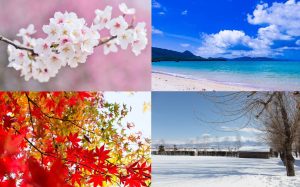
In Japan, the seasons—spring, summer, autumn, and winter—change every three months throughout the year. In spring, cherry blossoms and various other flowers bloom in vibrant colors; in summer, you can enjoy the fresh greenery and outdoor activities by the sea, mountains, and rivers. Autumn brings colorful foliage, and winter offers snowy landscapes—the rich scenery of each season is truly beautiful.
While there are other countries with four seasons, it’s rare to find such distinct and abundant seasonal changes as in Japan.
The Twenty-Four Solar Terms: Tracking Seasonal Changes Every 15 Days
The
“
Twenty-Four Solar Terms
” (Nijūshi Sekki) divides
the changes
of spring, summer, autumn, and winter into six periods
of 15 days each
. The “Seventy-Two Micro-seasons” (Shichijūni Kō) further divides these into three periods of five days each, adding even more detail.
Around the 4th century BCE, in ancient China, a method of determining the seasons based on the sun’s movement was developed to adjust for the seasonal shifts caused by the lunar calendar—this marked the beginning of the “Twenty-Four Solar Terms.” It is said to have been introduced to Japan around the 6th century and was used to aid in farming. Then, during the Edo period, the “Seventy-Two Micro-seasons” were created by adapting the Twenty-Four Solar Terms to Japan’s actual climate, geography, and flora and fauna.
Some of the names for these seasonal markers that are still in use today—such as Risshun (Start of Spring), Shunbun (Spring Equinox), Gajitsu (Summer Solstice), Shubun (Autumn Equinox), and Tōjitsu (Winter Solstice)—are terms we are all familiar with. Let’s start by introducing some of the most representative ones.
- Risshun (Start of Spring): The day after Setsubun. The beginning of spring (around February 4 on the Gregorian calendar)
- Spring Equinox: The day the sun reaches the vernal equinox (the point where the sun crosses the equator) (around March 21 on the Gregorian calendar)
- Summer Solstice: The day with the longest daylight hours and shortest night of the year (around June 21 on the Gregorian calendar)
- Autumnal Equinox: Like the Vernal Equinox, the day when day and night are of equal length (around September 23 on the Gregorian calendar)
- Winter Solstice: The day with the shortest daylight hours and the longest night of the year (around December 22 on the Gregorian calendar)
Since the winter solstice marks the shortest day of the year and the point from which the days begin to lengthen, it is referred to as “Ichiyō Raifuku” (the return of the sun) or “Tō no Shōgatsu” (the New Year of the Tang Dynasty). As it signifies the rising of a new sun, it was considered a major turning point and the starting point of the year in ancient times. The fact that customs such as bathing in yuzu-infused water and eating pumpkin on the winter solstice remain in Japan today likely stems from the importance placed on this seasonal milestone.
Similar to the Twenty-Four Solar Terms, there is also a Japanese way of interpreting the seasons known as “Zassetsu.” This is a uniquely Japanese method tailored to the climate, local conditions, and daily life. Terms like “Setsubun” and “Doyō” are still commonly used in seasonal events today.
